Cointelegraph.com
Source:
https://cointelegraph.com
Found 11869 news
-
Cointelegraph.com - 22:05 Jul 16, 2026
 The round of layoffs was part of Polygon transitioning operations to payments following a $250 million deal to acquire Coinme and Sequence in January. Marc Boiron, CEO of Polygon Labs, announced additional layoffs as the company finalizes its acquisition of cryptocurrency exchange Coinme. In a Thursday X post, Boiron said that Polygon would say “goodbye to many of [its] colleagues” as the company began the “transformation from operating as a blockchain foundation into operating as a blockchain-enabled payments company.” The move was part of a $250 million deal announced in January for Polygon to acquire Coinme and wallet infrastructure platform Sequence. “These changes are about the company we’re building, not the quality of the people leaving,” said Boiron. “A blockchain foundation and a blockchain-enabled payments company do not operate the same way. This transition means changing how we’re organized and the talent we need, not just what we build.” Read more
 -
Cointelegraph.com - 20:49 Jul 16, 2026
 According to ABC News, federal regulators are investigating whether the longtime White House staffer used nonpublic information to profit from event contracts tied to President Donald Trump’s speeches. US President Donald Trump’s longtime teleprompter operator is in talks with federal regulators to settle allegations that he used nonpublic information to profit from bets on Kalshi markets tied to the president’s speeches, ABC News reported Thursday, citing sources familiar with the matter. According to the report, Gabriel Perez, a technical assistant who has operated Trump’s teleprompter since 2016, allegedly placed bets on more than a dozen markets tied to Trump’s speeches, generating more than $100,000 in profits. Kalshi detected the activity through its surveillance systems and referred the trades to the Commodity Futures Trading Commission, the outlet said. The contracts were part of the platform’s “Mentions” markets, which allow users to bet on whether particular words, phrases or topics will appear in p...
 -
Cointelegraph.com - 20:29 Jul 16, 2026
 Bitcoin buyers have returned to spot, futures and ETF markets but geopolitical headwinds could quickly unravel the progress of the past two weeks. Bitcoin (BTC) spent the week split across two scenarios. One highlighted improving onchain buying pressure and ETF inflows, while the other remained synced to sentiment gauges and news events that projected fear. The spot and futures cumulative volume delta, a running tally of buy and sell orders, confirmed a $925 million net buying day for Bitcoin on July 15. This orderbook activity absorbed the entire post-CPI pullback in open interest and price rather than collapsing into it. Meanwhile, the spot Bitcoin ETFs added $107.7 million in net inflows on July 15, marking the second consecutive positive day following $181 million on July 14. Read more
 -
Cointelegraph.com - 20:05 Jul 16, 2026
 Anton Bukov said that he no longer took an active role at 1inch and had been “fired” in 2025 after pushing for changes to the company’s management and operations. Anton Bukov, the co-founder of 1inch, said that he was completely exiting his role in the company’s operations after more than seven years. In a Thursday X article, Bukov said that he had departed 1inch to launch a new project called Second Tier. Although he said he will remain a co-founder with a 50% ownership in the company, 1inch and Bukov released contradictory statements online regarding his role since last year. According to Bukov, he was “fired” from 1inch in November 2025 after “push[ing] for change” in the company’s management and operations. 1inch followed by posting its own account to X, saying that the co-founder “had not been actively involved in any associated organizations” related to the project since December 2025. Read more
 -
Cointelegraph.com - 19:27 Jul 16, 2026
 The company said the filing would create a regulated pathway for maintaining ownership records for tokenized securities onchain. Injective said Thursday it has filed a transfer agent registration with the US Securities and Exchange Commission, seeking to bring one of the core record-keeping functions of securities markets onto blockchain infrastructure. Transfer agents are a core part of US market infrastructure, maintaining shareholder records and tracking changes in securities ownership. Injective, a layer-1 blockchain focused on decentralized finance and tokenized real-world assets, said bringing that function onchain would create a regulated pathway for issuing and managing tokenized assets. Source: Injective Read more
 -
Cointelegraph.com - 18:45 Jul 16, 2026
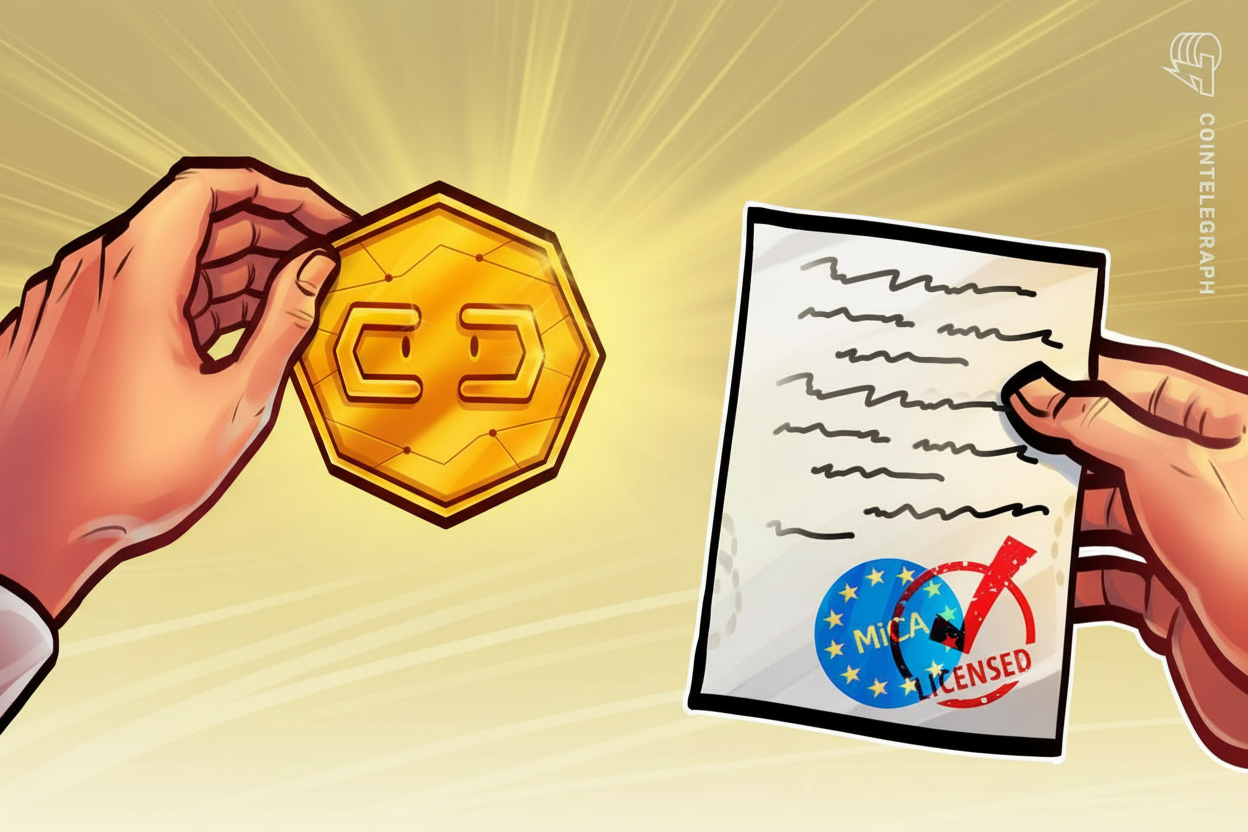 The Dutch Authority for the Financial Markets approved BitPay’s application as a crypto-asset service provider under the Markets in Crypto-Assets requirements. Crypto payments company BitPay announced that it had secured a license by the Dutch Authority for the Financial Markets, allowing the company to operate in European Union member states under the Markets in Crypto-Assets (MiCA) framework. On Thursday, BitPay said that the approval as a crypto-asset service provider (CASP) by Dutch financial authorities would allow the company to expand its services in the region, including crypto and stablecoin payments. The company was one of the latest to be licensed under MiCA following a July 1 requirement for all entities offering crypto-related services to be regulated. “Europe is one of the most important regions for the future of payments,” said BitPay’s European head, Jonathan Arler. Read more
 -
Cointelegraph.com - 16:58 Jul 16, 2026
 Bitcoin fell 1.5% from local highs amid a reversal in US stocks as markets moved from bullish US inflation cues to retail profit-taking. Bitcoin (BTC) cooled off with US stocks on Thursday as tech selling tempered gains from low inflation. Key points: Read more
 -
Cointelegraph.com - 16:47 Jul 16, 2026
 A former CFTC commissioner urged lawmakers not to “kill all the hard work that we put in the rest of the bill” by making ethics a make-or-break issue on crypto market structure. Summer Mersinger, the CEO of the Blockchain Association and a former commissioner at the US Commodity Futures Trading Commission (CFTC), anticipated a vote on a cryptocurrency market structure bill as soon as next week with the window closing for lawmakers before August state work periods. Speaking at the Injective Summit in Washington, DC, on Thursday, Mersinger said that US lawmakers working to advance the Digital Asset Market Clarity (CLARITY) Act in Congress had a “few little nits that they’re still working out” but were “very close on the main part of the language” around the bill. According to the Blockchain Association CEO, a vote in the Senate could come as early as next week, provided lawmakers reached an agreement on ethics. “Ethics is the big elephant in the room,” said Mersinger on the crypto bill. “That’s what we hear fr...
 -
Cointelegraph.com - 16:32 Jul 16, 2026
 Eligible E*TRADE retail clients can now buy, sell and hold Bitcoin, Ether and Solana through a partnership with crypto infrastructure provider Zero Hash. Morgan Stanley’s E*TRADE platform has launched spot cryptocurrency trading, allowing eligible clients to buy, sell and hold Bitcoin, Ether and Solana through a partnership with crypto infrastructure provider Zero Hash. Clients can view their crypto holdings alongside stocks and other traditional investments on the E*TRADE platform, while transfer functionality for moving digital assets on and off the platform is expected later this year. The self-directed channel served 8.6 million households and held about $1.56 trillion in client assets as of March 31, according to Morgan Stanley’s latest financial supplement. Read more
 -
Cointelegraph.com - 16:19 Jul 16, 2026
 Tradable will bring up to $1 billion in private credit assets to Stellar, extending the blockchain’s push into institutional finance and tokenized real-world assets. Tokenization platform Tradable plans to bring up to $1 billion in private credit assets onto the Stellar blockchain, expanding institutional access to tokenized real-world assets (RWAs) as demand for onchain private markets continues to grow. Tradable said Thursday that $500 million in notional value is expected to be available when the initiative launches, and it will increase the amount to $1 billion over time. The company will use Stellar’s network to support institutional functions, including compliance, investor onboarding and asset lifecycle management. The timing of the initiative’s launch was not disclosed. Read more
 -
Cointelegraph.com - 13:34 Jul 16, 2026
 The BNP-backed brokerage infrastructure provider is expanding into tokenized markets and AI-native financial services as both DeFi and TradFi companies pursue onchain business. Brokerage infrastructure provider Alpaca said Thursday that it raised $135 million in a funding round led by Peak XV, along with as much as $300 million in debt financing from Kraken parent Payward and BMO. A January Series D round pulled in $150 million that brought the fintech’s value to $1.15 billion, according to the statement. Earlier investors include the venture capital arm of BNP Paribas. Alpaca said it will use the new financing to accelerate its agent-first brokerage and API-first prime brokerage infrastructure. Read more
 -
Cointelegraph.com - 13:30 Jul 16, 2026
 Users spent a record $324 million on onchain gacha in June, even as Bitcoin hit a 21-month low. The thrill of scoring a top Pokemon card from a random pack is becoming big business June 2026 was brutal for the crypto market. Bitcoin (BTC) fell more than 20%, hitting a 21-month low, while spot Bitcoin ETFs saw a record $4.5 billion in outflows. That did not stop users from spending a record $324 million on onchain gacha during the month, according to Blockworks Research. A year earlier, the monthly figure was closer to $50 million. Spending hit a new all time high in the depths of a bear market. While crypto prices were tanking, people were opening more and more packs of tokenized Pokémon cards — driven by the thrill, the hope of a profit or the urge to expand a collection. It’s an entire randomized Real World Asset (RWA) sector that’s flown under the radar… until now. Read more
 -
Cointelegraph.com - 13:05 Jul 16, 2026
 Prediction markets reached a record $113.8 billion in notional volume in Q2 as spot CEX trading, derivatives volume and stablecoin market cap declined. Cryptocurrency markets struggled broadly in the second quarter of 2026, with declines across stablecoins, spot trading and derivatives, but prediction markets reached record highs. Spot trading volume across the top 10 centralized exchanges (CEXs) fell to $1.95 trillion in the second quarter of 2026, a 27.9% drop from $2.7 trillion in Q1, according to CoinGecko’s latest Crypto Industry Report published Thursday. CEX perpetual futures volume also declined 10% to $12.7 trillion, while the stablecoin market slipped 1.6% to $305.1 billion. In contrast, prediction markets recorded their strongest quarter on record with $113.8 billion in notional volume. Read more
 -
Cointelegraph.com - 13:00 Jul 16, 2026
 MoonPay acquired Glide, a crypto infrastructure startup founded by former Robinhood Wallet engineers, to expand cross-chain crypto deposit infrastructure. MoonPay has acquired the crypto infrastructure startup Glide, integrating Glide’s deposit and routing technology, the companies said in a joint announcement shared with Cointelegraph on Thursday. MoonPay, a financial technology platform that provides fiat-to-crypto payment services, said the deal is part of MoonPay’s broader effort to become a digital asset infrastructure provider, adding capabilities beyond its original crypto payments business. Glide was founded in 2023 by Tushar Soni and Qinyu Tong, former members of the team behind Robinhood Wallet. The company was founded to help applications accept deposits from different tokens, wallets, exchanges and payment sources. Glide supports more than 100 tokens across 30 blockchain networks, according to the platform’s documentation. Read more
 -
Cointelegraph.com - 12:35 Jul 16, 2026
 The market capitalization of tokenized stocks rose to a record $2.3 billion, as investors sought exposure to the growing list of tokenized equity products launched by cryptocurrency exchanges. The global market capitalization of tokenized stocks rose to a record $2.3 billion on Wednesday, as more investors sought exposure to blockchain-based equity products. The Ethereum network boasted the largest market share, at 34%, followed by BNB Chain with 30% and the Solana network with 23%, data aggregator Token Terminal shared in a Wednesday X post. The largest increase came from Kraken exchange’s xStocks, which accounted for $507 million worth of tokenized stocks and Binance’s bStocks, with $334 million. Ondo Finance remained the largest tokenized stock issuer with $955 million in onchain equities, according to Token Terminal data. Read more
 -
Cointelegraph.com - 12:05 Jul 16, 2026
 The global task force said criminal networks are using stablecoins and developing proprietary tokens to evade asset freezes as countries struggle to enforce crypto AML rules. The Financial Action Task Force (FATF) warned that criminals are increasingly exploiting stablecoins for illicit finance, with most identified onchain criminal activity now involving the dollar-pegged cryptocurrencies. In its latest report published Thursday, the global anti-money laundering watchdog said criminal networks have also begun developing proprietary stablecoins designed to resist freezing and asset seizures. The FATF urged jurisdictions to accelerate implementation of crypto AML standards as illicit actors exploit regulatory gaps. Read more
 -
Cointelegraph.com - 11:35 Jul 16, 2026
 ARK Invest’s director of research disputed a16z crypto’s thesis that traditional finance will adopt permissioned blockchain infrastructure instead of decentralized finance, saying institutions will increasingly rely on DeFi rails. ARK Invest’s director of research pushed back against investor a16z crypto’s thesis that traditional finance will adopt blockchain through permissioned infrastructure rather than decentralized finance (DeFi). Lorenzo Valente said in a Wednesday X post that public blockchains have already outperformed private blockchain initiatives, citing the growth of tokenized assets on Ethereum and other open networks. He added that crypto-native firms such as Circle and Coinbase, rather than incumbent financial institutions, are best positioned to build the next generation of financial infrastructure. Read more
 -
Cointelegraph.com - 10:33 Jul 16, 2026
 Visa and Artemis found that infrastructure bottlenecks are preventing broader commercial adoption of the autonomous AI agent economy. Artificial intelligence (AI) agents are posing a challenge to the incumbent global card payments infrastructure that is struggling to process high-frequency micropayments, according to a joint report released by payments giant Visa and investment thesis platform Artemis. The joint report published Wednesday found that traditional cards were built for human commerce with low-frequency transactions, which is insufficient for AI agents, which need infrastructure with near-zero fees and faster settlement to make agentic micropayments commercially viable. New infrastructure is increasingly necessary since AI agents crossed a key capability threshold in mid-2025, enabling them to discover unfamiliar APIs, evaluate prices and decide on autonomous payments. Read more
 -
Cointelegraph.com - 09:26 Jul 16, 2026
 The Senate approved a resolution opposing clemency for former FTX CEO Sam Bankman-Fried as prediction markets put the odds of a Trump pardon by July 31 below 1%. The US Senate has adopted a resolution opposing executive clemency for former FTX CEO Sam Bankman-Fried, the convicted crypto executive behind one of the industry’s largest collapses. The Senate has agreed by unanimous consent to the simple resolution (S. Res. 772), with a nonbinding measure stating that Bankman-Fried should not receive executive clemency, according to a Wednesday X post by the Senate Press Gallery. The resolution affirms the Senate’s commitment to the rule of law and the integrity of the US financial system following Bankman-Fried’s conviction on fraud and conspiracy charges related to FTX’s collapse. Read more
 -
Cointelegraph.com - 08:27 Jul 16, 2026
 Tether reportedly invested $20 million into Ualá, as part of the Argentine neobank’s $197 million funding round announced earlier in March. Stablecoin giant Tether reportedly invested $20 million in the Argentine neobank Ualá, as part of its broader push in Latin America. The investment formed part of a $197 million equity funding round announced by Ualá in March and led by Allianz X, according to Bloomberg. Ualá disclosed Tether as a participant in the round at the time but did not reveal the size of its investment. Cointelegraph contacted Tether for confirmation but had not received a response by publication. Read more
11869 items