Cointelegraph.com
Source:
https://cointelegraph.com
Found 11876 news
-
Cointelegraph.com - 10:59 Jul 01, 2026
 Bitcoin and Ether open interest fell sharply after $8.35 billion in long liquidations, while ETF outflows, weaker Strategy purchases and declining market depth reduced liquidity. Cryptocurrency markets entered the third quarter of 2026 with less leverage but thinner liquidity after a wave of liquidations cleared speculative positions while major sources of demand weakened during the second quarter. According to a market update from institutional data provider Talos, Bitcoin (BTC) and Ether (ETH) long liquidations totaled $8.35 billion in Q2. The data provider pointed out that the deleveraging coincided with spot Bitcoin exchange-traded fund (ETF) outflows, reduced Bitcoin buying by Strategy and a contraction in stablecoin supply. While the reset left the market more stable heading into Q3, Talos said reduced order-book depth weakened its ability to absorb renewed selling pressure. This means the market could be less vulnerable to a chain reaction of forced selling, but prices may still swing sharply becaus...
 -
Cointelegraph.com - 09:22 Jul 01, 2026
 US spot Bitcoin ETFs logged a record $4.5 billion in June outflows, pushing year-to-date totals to $5.5 billion, signaling an unprecedented pace of withdrawals. US-listed spot Bitcoin exchange-traded funds (ETFs) posted a record $4.5 billion in net outflows in June, more than three times the $1.25 billion Strategy is authorized to raise through its new Bitcoin monetization program. The record monthly withdrawals pushed US spot Bitcoin ETFs to roughly $5.5 billion in year-to-date net outflows for 2026, reducing cumulative net inflows since the funds launched to about $51.2 billion, according to SoSoValue data updated on Wednesday. BlackRock's iShares Bitcoin Trust (IBIT) accounted for about 79% of June's withdrawals, posting $3.55 billion in net outflows, according to Farside Investors. Read more
 -
Cointelegraph.com - 08:20 Jul 01, 2026
 Former Goliath Ventures CEO Christopher Delgado pleaded guilty to fraud and money laundering and agreed to forfeit properties, vehicles, luxury goods and crypto wallets. Former Goliath Ventures CEO Christopher Alexander Delgado pleaded guilty to his role in a crypto investment scheme that prosecutors said raised at least $400 million from investors. On Tuesday, the US Department of Justice (DOJ) said Goliath promised investors monthly returns generated through digital asset liquidity pools between January 2023 and January 2026. Prosecutors said the funds were instead used to pay earlier investors, process withdrawals, fund luxury spending and finance business events. Read more
 -
Cointelegraph.com - 06:15 Jul 01, 2026
 Taiwan’s legislative branch has passed the nation’s first crypto and stablecoin rules, which aim to integrate the country with the global crypto market. Taiwanese lawmakers on Tuesday passed a law to establish a regulatory framework for crypto, which includes licensing and rules for stablecoins. Taiwan's financial watchdog, the Financial Supervisory Commission (FSC), said that the Legislative Yuan passed the law requiring all virtual asset service providers, or VASPs, to get approval from the regulator to operate. The law also says stablecoins issued in Taiwan must get approval from the central bank and the FSC, and issuers must maintain sufficient reserves with a trustee and undergo regular audits. Read more
 -
Cointelegraph.com - 06:14 Jul 01, 2026
 Claude Fable 5 will be redeployed with a new set of classifiers designed to identify and block a broader range of cybersecurity-related tasks. Artificial intelligence company Anthropic is set to restore public access to its most powerful AI models, Claude Fable 5 and Mythos 5, weeks after they were pulled offline under a directive from the US government. Anthropic’s two latest models have been restricted from public access since June 12, when the government applied export controls following a report in which researchers bypassed Fable 5’s safeguards, forcing Anthropic to pull all access to the models immediately. The government lifted those restrictions on Wednesday, stated Anthropic. “After a series of productive conversations with the US government, we’re redeploying the model with a new set of classifiers to target and block more cybersecurity tasks,” Anthropic said. Read more
 -
Cointelegraph.com - 04:01 Jul 01, 2026
 Memecoin sales and royalties made the most money for Trump last year, more than all of his golf courses combined. US President Donald Trump’s cryptocurrency ventures generated more income for him in 2025 than his real estate and resort businesses, according to his latest financial disclosures. Donald Trump’s annual financial disclosure report was released by the US Office of Government Ethics on Tuesday, revealing more than $1.4 billion in income from crypto-related ventures last year. The filings show Trump has profited substantially from an industry that he’s simultaneously regulating, which critics say creates a conflict of interest. In 2025, his administration pushed pro-crypto policy, a friendlier regulatory environment and executive orders favorable to digital assets, while his family’s ventures generated vast income as crypto markets surged to an all-time high. Read more
 -
Cointelegraph.com - 03:47 Jul 01, 2026
 Carl Rinsch will serve two and a half years in prison for taking money meant for a Netflix show to buy Dogecoin, stocks and luxury goods. Hollywood director Carl Rinsch has been sentenced to two and a half years in prison for defrauding Netflix out of $11 million, which he spent on crypto, stocks and luxury goods. A Manhattan federal court on Monday sentenced Rinsch, known for directing the 2013 film “47 Ronin,” starring Keanu Reeves, to 30 months in prison after he was convicted in December on charges including fraud and money laundering. “Rinsch orchestrated a scheme to steal millions by seeking $11 million from a subscription streaming service, falsely claiming that money would be used to finance a television show that he was creating,” Manhattan US Attorney Jay Clayton said in a statement Monday. Read more
 -
Cointelegraph.com - 02:30 Jul 01, 2026
 One Binance customer said he lost the equivalent of more than $132,000 from the crypto exchange’s derivatives offerings before restrictions were imposed on Binance. Almost 1,700 UK investors are reportedly suing Binance and its founder Changpeng Zhao for 150 million British pounds ($200 million), alleging the crypto exchange offered and sold crypto derivatives without regulatory approval. The law firm representing the investors, KP Law, said Binance’s leverage tokens, futures contracts and options offerings breached the Financial Services and Markets Act 2000 and that these products continued to be offered after the Financial Conduct Authority banned such products from being offered to retail customers in January 2021. “There appeared to be no effective barrier preventing UK customers from accessing them,” the law firm said. Read more
 -
Cointelegraph.com - 23:11 Jun 30, 2026
 Strategy's latest plan includes MSTR and STRC buybacks, expanded cash reserves and even potential Bitcoin sales. Will it be enough to defuse the overheated “death spiral” fears? With Bitcoin plunging below $60,000 and Strategy’s share price down by more than 70% from the high, some crypto investors are questioning if Strategy could become this cycle’s Terra/LUNA — a highly leveraged bet on crypto market structure that explodes under stress. The company's response? A new capital framework released on Monday aimed at addressing investors’ fears. The package includes up to $1 billion in buybacks for MSTR, up to $1 billion in buybacks for STRC and related securities, an increase in STRC’s dividend to roughly 12%, and a cash buffer expansion to $2.55 billion. Read more
 -
Cointelegraph.com - 21:49 Jun 30, 2026
 Bitcoin's recent selloff brought it within 10% of its realized price — a line that has marked the bottoming zone in Bitcoin's previous bear markets. Bitcoin (BTC) is fast approaching a buying level that analysts describe as a top “investment opportunity.” Key points: Read more
 -
Cointelegraph.com - 21:44 Jun 30, 2026
 The amended complaint, granted by a judge on Tuesday, included allegations that Kalshi targeted users under 21 years old through social media and marketing on university campuses. Prediction markets platform Kalshi’s legal battle against Massachusetts will continue after a judge ruled that state authorities could add allegations against the company over sports betting. In a Tuesday filing in Suffolk County Superior Court, associate justice Peter Krupp allowed state authorities to file a 71-page amended complaint, building on a filing alleging that Kalshi engaged in sports wagering in violation of state laws. The amended complaint included allegations that Kalshi “targets those under 21 years of age and does little to stop them from using its platform,” citing the company’s marketing to university campuses and presenting images in ads of people who “appear to be younger than 21 years old.” Read more
 -
Cointelegraph.com - 21:16 Jun 30, 2026
 Tokenization and RWA TVL growth highlight Ethereum’s fundamentals, but stagnant DApps and spot ETF outflows keep the pressure on ETH price. Key takeaways: Ether (ETH) has failed to sustain prices above $1,600 since Thursday, following the broader cryptocurrency market's downtrend. Lower oil prices created a positive tone that fueled investors’ hopes for more expansionist monetary policy. That setup favors stocks and pushes bond yields higher. Traders now fear that ETH will not hold the $1,500 support level for long. Spot Ether ETF outflows void the impact of accumulation from Ether treasury companies. Read more
 -
Cointelegraph.com - 20:38 Jun 30, 2026
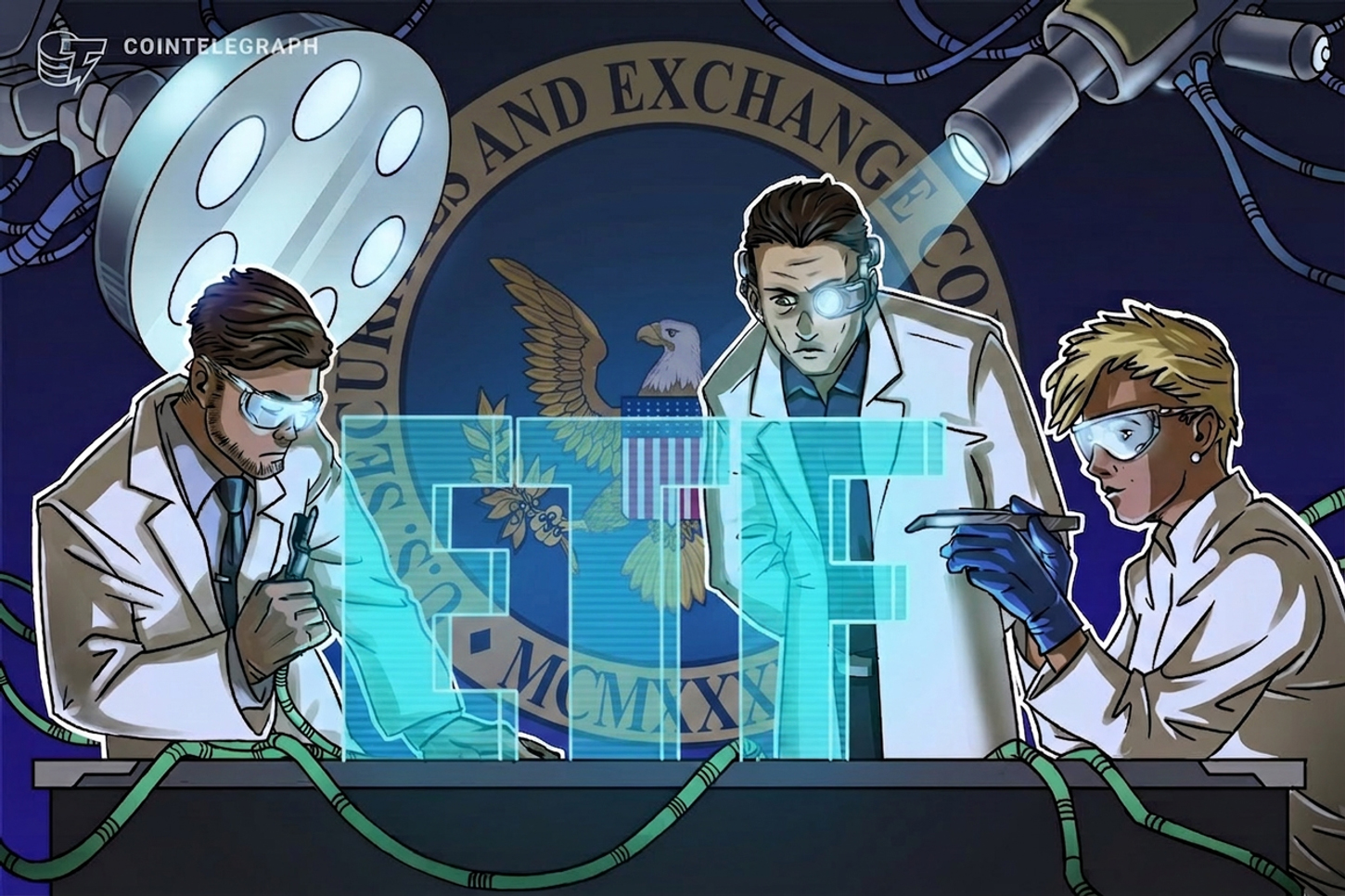 The request from the US agency seeks feedback on how emerging ETF structures and investment strategies should be regulated as issuers roll out increasingly specialized products. The US Securities and Exchange Commission (SEC) has requested public comment on exchange-traded funds (ETFs) investing in novel asset classes or using new investment strategies, as the agency reviews how such products should be regulated. The consultation seeks feedback on whether existing rules adequately address novel ETFs, how such funds should be regulated and whether changes to the registration process are needed as new products enter the market. According to the regulatory agency, the request focuses on funds investing in innovative asset classes or employing new investment strategies, where it is evaluating whether existing regulations remain appropriate. Read more
 -
Cointelegraph.com - 19:31 Jun 30, 2026
 The project, supported by Visa, Mastercard and many crypto companies, could be in a position to challenge Tether’s USDT and Circle’s USDC, currently the two largest stablecoins by market capitalization. More than 140 companies have signed onto a US dollar-pegged stablecoin project that allows them to “receive all of the earnings” from its reserves. In a Tuesday notice, Open Standard said it was launching the Open USD (OUSD) stablecoin, a US dollar-pegged coin supported by financial companies including Visa and Mastercard, as well as crypto companies Coinbase, Ripple, OKX and Bybit. The project will allow businesses to mint OUSD “at no cost and with no artificial limits on volume,” and keep earnings from the coin’s reserves. “When Visa, Stripe, Mastercard, Coinbase and Google coordinate on a new stablecoin, the signal is unmistakable,” said Rhino.fi co-founder and CEO Will Harborne. “Open USD is the first launch with a real chance to win share from USDT and USDC, because reserve revenue flows back to everyone ...
 -
Cointelegraph.com - 18:46 Jun 30, 2026
 The partnership extends distribution of Nasdaq's TotalView market data to blockchain applications and other software platforms through Pyth's marketplace. Nasdaq has selected Pyth, an onchain financial data network, to distribute its proprietary market data to blockchain applications and other software platforms. The partnership initially covers Nasdaq TotalView, the exchange’s depth-of-book data feed, which includes every displayed buy and sell order across all price levels as well as order imbalance data around the opening and closing auctions. The feed is widely used by professional traders because it provides a more complete view of market liquidity than standard market quotes by displaying the full order book. According to Pyth, the marketplace gives software applications access to first-party market data through a single integration. The company said the service is intended for blockchain applications, digital asset exchanges, prediction markets, trading systems and other software platforms. Read more
 -
Cointelegraph.com - 18:17 Jun 30, 2026
 Bitcoin faced downside pressure as the US dollar hit its highest levels against the Japanese yen since 1986, while BTC price analysis revealed "capitulation" by 2025 top-buyers. Bitcoin (BTC) fell toward $58,000 around Tuesday’s Wall Street open as the clock ticked down to a brutal quarterly close. Key points: Read more
 -
Cointelegraph.com - 17:44 Jun 30, 2026
 Bitcoin miners have the power sites AI companies need, but turning old mining campuses into real data center revenue is no easy pivot. By the end of 2025, the power capacity tied to artificial intelligence data centers worldwide had reached about 29.6 gigawatts (GW), enough to run all of New York state at peak demand, according to Stanford University’s annual report on the AI industry. The report, released in April, suggests that compute itself is abundant and getting cheaper. Permitted, grid-connected, ready-to-draw electricity is in high demand, but the sources to power it are much harder to come by. One industry has spent the past decade quietly building exactly that infrastructure for a different reason: Bitcoin mining. Read more
 -
Cointelegraph.com - 17:19 Jun 30, 2026
 The crypto industry, big tech and gambling interest groups are betting big on politicians in the 2026 primaries and elections, with almost $300 million shelled out so far. The US consumer advocacy group Public Citizen on Tuesday reported that the cryptocurrency industry had contributed $189 million toward the 2026 election cycle, following its 2024 playbook. According to a report released Tuesday, the nonprofit organization said that about 37% of all corporate contributions in the 2026 US election cycle could be traced to crypto companies, totaling about $189 million so far, with more than four months until the November election. While the watchdog group said that the crypto-aligned political action committee (PAC) Fairshake was responsible for spending more than $82 million so far, the MAGA Inc. Super PAC, largely backed by Crypto.com, had spent more than $56 million. Read more
 -
Cointelegraph.com - 16:34 Jun 30, 2026
 The majority of businesses surveyed are likely to use stablecoins within the next 12 months, while regulatory clarity remained the biggest barrier to wider adoption. Business use of stablecoins is poised to surge in the next 12 months as adoption of the digital currency goes mainstream, according to a new report from payments infrastructure firm Cybrid. The report found 42% of businesses surveyed are already using stablecoins for cross-border payments and 88% of respondents said they are likely or very likely to use stablecoins within the next 12 months. Still, only 2% identified as committed users of traditional payment rails. Businesses using stablecoins reported average cross-border payment cost savings of 35%, with companies processing more than $100 million in monthly payment volume reporting average savings of up to 47%, according to the survey. Read more
 -
Cointelegraph.com - 14:00 Jun 30, 2026
 MetaMask launches Money Account it says offers up to 4% variable APY on mUSD stablecoin balances and card spending, with DeFi-powered yield via vaults, excluding the UK and sanctioned jurisdictions. Update, June 30, 6:13 pm UTC: This article has been updated to correct the availability of MetaMask Money Account. Consensys said the Money Account is unavailable in the United Kingdom and sanctioned jurisdictions, not the European Union. MetaMask, a self-custodial wallet developed by Consensys, is launching a new product that it says lets users earn yield on its MetaMask USD (mUSD) stablecoin and spend it via a card exclusively on the Monad blockchain. The company on Tuesday announced the launch of Money Account, a product it says offers up to 4% variable annual percentage yield (APY) on eligible stablecoin deposits in supported jurisdictions. Read more
11876 items