Cointelegraph.com
Source:
https://cointelegraph.com
Found 11887 news
-
Cointelegraph.com - 09:12 Feb 06, 2026
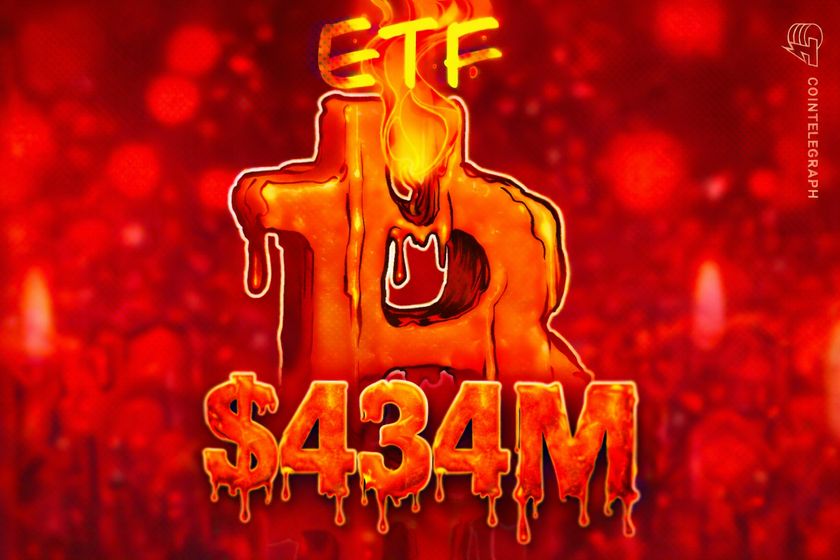 Net weekly outflows from Bitcoin ETFs reached $690 million as BTC briefly touched $60,000, reigniting analyst criticism over “paper Bitcoin” and scarcity. Bitcoin exchange-traded funds (ETFs) continued to see outflows on Thursday, shedding almost $1 billion over the past two days as debate grows over their potential impact on the market. Data from SoSoValue shows that spot Bitcoin (BTC) ETFs recorded $434 million in net outflows on Thursday, following $545 million in redemptions the previous day. Monday’s $561 million in inflows was not enough to offset losses, leaving net weekly outflows at about $690 million as of Friday morning. Read more
 -
Cointelegraph.com - 08:45 Feb 06, 2026
 Metaplanet CEO Simon Gerovich is sticking with the company’s Bitcoin accumulation plan despite a brutal drawdown in both its stock and the wider crypto market. Metaplanet’s CEO Simon Gerovich doubled down on the company’s Bitcoin-first strategy as the wider crypto market suffered one of its harshest drawdowns since 2022. “[T]here is no change to Metaplanet’s strategy. We will steadily continue to accumulate Bitcoin, expand revenue and prepare for the next phase of growth,” Gerovich said Friday on X, according to a machine translation of his post. Metaplanet’s stock on the Tokyo Stock Exchange closed Friday down 5.56% at 340 yen (about $2.16). Read more
 -
Cointelegraph.com - 05:58 Feb 06, 2026
 Santiment says the pattern of large holders selling while retail scoops up Bitcoin is “what historically creates bear cycles.” Large Bitcoin holders are now controlling the smallest share of the cryptocurrency’s supply since late May, when it first reclaimed $100,000 after more than three months, according to crypto sentiment platform Santiment. Santiment posted to X on Thursday that “whale and shark wallets” holding between 10 and 10,000 Bitcoin (BTC) have fallen to a nine-month low, collectively accounting for about 68.04% of the entire Bitcoin supply. “This includes a dump of -81,068 BTC in just the past 8 days alone,” Santiment said, as Bitcoin fell from around $90,000 to $65,000 over the same period, a roughly 27% decline, according to CoinMarketCap. Bitcoin is trading at $64,792 at the time of publication, up from a 24-hour low of just over $60,000. Read more
 -
Cointelegraph.com - 05:19 Feb 06, 2026
 Tether and Gold.com are exploring options to allow the use of Tether’s stablecoins to purchase physical gold. The investment arm of stablecoin issuer Tether has acquired a $150 million stake in the precious metals platform Gold.com to expand access to tokenized gold. Tether said on Thursday that it acquired an approximately 12% stake in the company, which will integrate Tether Gold (XAUt), its gold-backed cryptocurrency, into Gold.com’s platform. Gold.com is a publicly listed online marketplace that sells gold and other precious metals, such as silver and platinum, to several markets, including the US. Read more
 -
Cointelegraph.com - 05:05 Feb 06, 2026
 US Treasury Secretary Scott Bessent says banks and crypto may begin to offer similar products, and pledged to prevent deposit flight concerns that are stalling a key crypto bill. US Treasury Secretary Scott Bessent has told Congress that traditional and crypto banking products and services may be more intertwined in the future. Appearing before the Senate Banking Committee on Thursday, Bessent was asked by Republican Senator Cynthia Lummis whether there could come a time when conventional banks and crypto are offering the same types of products. “I think that can happen over time,” Bessent said. “We’ve actually been working with small and community banks to discuss how they can be part of the digital asset revolution.” Read more
 -
Cointelegraph.com - 04:45 Feb 06, 2026
 Crypto mining stocks have declined across the board the value of the entire crypto market fell almost 9% on Thursday. Shares in crypto mining companies IREN and CleanSpark sank on Thursday as their earnings came in below Wall Street expectations and Bitcoin’s slide saw traders turn risk-off. Bitcoin (BTC) has fallen 12% over the past 24 hours to briefly touch a low of $60,000 early on Friday. Meanwhile, the crypto market capitalization fell by almost 9%, according to CoinMarketCap. CleanSpark (CLSK) led the decline, closing trading on Thursday down 19.13% and falling another 8.6% after-hours to $7.55 after its results for the quarter ended Dec. 31 came in below analyst predictions. Read more
 -
Cointelegraph.com - 03:47 Feb 06, 2026
 Kalshi has seen nearly $170 million in Super Bowl-related bets, and its move to boost oversight comes amid scrutiny of prediction markets by regulators and Congress. Kalshi says it’s expanding its surveillance on its prediction markets platform through an independent advisory committee and partnerships to detect insider trading and market manipulation, just days ahead of the Super Bowl. Kalshi said on Thursday that the committee would give a quarterly rundown to the company’s outside counsel and publish statistics on investigations into suspicious activity on the platform. It is also teaming up with crypto trading surveillance platform Solidus Labs and Daniel Taylor, director of the Wharton Forensic Analytics Lab, “to detect, investigate, and address market abuse.” Read more
 -
Cointelegraph.com - 03:01 Feb 06, 2026
 Bitcoin plummeted to a low of around $60,000 after the Crypto Fear & Greed Index hit its lowest score since mid-2022, when the Terra blockchain collapsed. Crypto market sentiment has slumped to its lowest level in over three and a half years, with Bitcoin falling by double-digit percentage points to around $60,000. The Crypto Fear & Greed Index fell to a score of 9 out of 100 on Friday, indicating “extreme fear” in the market and hitting its lowest point since June 2022, when sentiment and the market fell in the wake of the collapse of the Terra blockchain a month earlier. The index has been at a low for the last fortnight as Bitcoin (BTC) has tanked 38% from its 2026 high of $97,000 in just three weeks, wiping out all gains for the past sixteen months. Read more
 -
Cointelegraph.com - 01:52 Feb 06, 2026
 Traders were active in BlackRock’s iShares Bitcoin Trust ETF on Thursday as Bitcoin plummeted, falling 12% in the last 24 hours. BlackRock’s spot Bitcoin exchange-traded fund (ETF) has reportedly seen an all-time peak daily trading volume as traders responded to Bitcoin’s rapidly crashing price. The iShares Bitcoin Trust ETF (IBIT) “crushed its daily volume record” on Thursday, with $10 billion worth of shares trading hands, Bloomberg ETF analyst Eric Balchunas said on X. Balchunas added that IBIT dropped 13% on the day, its “second-worst daily price drop since it launched,” with its biggest daily price crash coming in at 15% on May 8, 2024. Read more
 -
Cointelegraph.com - 23:36 Feb 05, 2026
 Strategy executives Phong Le and Andrew Kang say the company is on a strong financial footing despite it now being down 17.5% on its Bitcoin holdings. The Bitcoin buying company Strategy reported a net loss of $12.4 billion in the fourth quarter of 2025, driven down by Bitcoin’s 22% fall over the quarter. Bitcoin (BTC) reached a peak high of $126,000 in early October, but tumbled over the quarter ending Dec. 31 to under $88,500. Bitcoin is down 30% so far this year to $64,500, below Strategy’s average cost per BTC of $76,052. Strategy (MSTR) said on Thursday that, despite the loss, its Q4 revenues rose 1.9% year-on-year to $123 million, driven in part by its business intelligence arm. However, the recent Bitcoin sell-off saw its shares close 17% lower on Thursday to $107. Read more
 -
Cointelegraph.com - 22:17 Feb 05, 2026
 Bitcoin fell below 63,000 as investors reacted to dismal US economic data, a weakening stock market and fears of an AI industry bubble. Does data forecast a return to $90,000 by March? Key takeawys: Bitcoin fell below $63,000 as weak US job data and concerns over AI industry investments fueled investor risk aversion. Options markets show a 6% chance of Bitcoin returning to $90,000 by March. Read more
 -
Cointelegraph.com - 21:42 Feb 05, 2026
 European tokenization companies urged EU lawmakers to quickly amend the DLT Pilot Regime, warning that current limits risk pushing onchain markets to the US. A group of European tokenization operators has urged EU policymakers to swiftly amend the bloc’s DLT Pilot Regime, warning that current asset limits, volume caps and time-limited licenses are preventing regulated onchain markets from scaling as the United States advances toward industrial-scale tokenization and near-instant settlement. In a joint letter coordinated ahead of an upcoming parliamentary debate, tokenization and market infrastructure companies Securitize, 21X, Boerse Stuttgart Group, Lise, OpenBrick, STX and Axiology called for targeted changes to the DLT Pilot Regime, the EU’s regulatory sandbox for tokenized securities markets. The companies said the EU’s broader Market Integration and Supervision Package sets the right long-term direction, but warned that existing constraints are already limiting the growth of regulated tokenized products ...
 -
Cointelegraph.com - 20:28 Feb 05, 2026
 Gemini, a US-based cryptocurrency exchange founded in 2015, will focus on growth in the United States due to its deep capital markets. Crypto exchange Gemini announced its exit from the United Kingdom, European Union and Australia markets on Thursday, as the company slashed its workforce by 25%. Gemini cited artificial intelligence automating labor and making engineers “100x” more efficient, and a more challenging business environment in the UK, EU and Australia, as reasons for the exit, according to Thursday’s announcement: “We don’t have the demand in these regions to justify them. The reality is that America has the world’s greatest capital markets,” the announcement said. Read more
 -
Cointelegraph.com - 20:21 Feb 05, 2026
 Bitcoin touched new lows under $64,000 as market selling reached a historic level, and analysts warn that the bottom is not in. Does data support analysts’ sub-$60,000 prediction? Bitcoin (BTC) has fallen 13% over the past four days, sliding to $63,844 from $79,300. It is currently trading below $69,000, which is the 2021 bull market high, a level many see as a support level. The drop was matched by a sharp decline in futures activity, with BTC’s open interest falling by more than $10 billion over the past seven days. Analysts are now focusing on the long-term technical zones and onchain indicators that may signal a major turning point for BTC. Read more
 -
Cointelegraph.com - 20:07 Feb 05, 2026
 The investment extends an existing partnership with Anchorage and comes as the federally regulated crypto bank explores a major capital raise ahead of a potential IPO. Tether has made a $100 million strategic equity investment in Anchorage Digital, formalizing an existing relationship between the stablecoin issuer and the federally regulated US crypto bank. According to a post by Tether on Thursday, the investment builds on the companies’ prior collaboration, which includes Anchorage Digital’s role as the issuer of USAt, which launched on Jan. 27. USAt is dollar–pegged stablecoin designed to operate in the United States under the federal payment stablecoin framework established by the GENIUS Act in July 2025. Read more
 -
Cointelegraph.com - 17:44 Feb 05, 2026
 Panic selling by short-term holders, extreme fear, and oversold RSI suggested that BTC could be nearing the final phase of capitulation. Bitcoin (BTC) sellers resumed their activity on Thursday as the BTC price dropped below $69,000, the lowest since Nov. 6, 2024. Analysts said that Bitcoin showed signs of “full capitulation” and a potential bottom forming, due to extreme market fear, panic selling by short-term holders and the relative strength index (RSI). Key takeaways: Read more
 -
Cointelegraph.com - 17:34 Feb 05, 2026
 Aster rebranded to become a crypto perpetual futures decentralized exchange in 2025, as perp DEX trading volume surged by trillions of dollars. The Aster decentralized crypto exchange (DEX) and perpetual futures platform announced on Thursday that its layer-1 blockchain testnet is now live for all users, with a potential rollout of the Aster layer-1 mainnet in Q1 2026. Several new features are slated for a Q1 launch, including fiat currency on-ramps, the release of the Aster code for builders and the upcoming L1 mainnet, according to the Aster roadmap. Aster will focus on infrastructure, token utility and building its ecosystem and community in 2026, according to the roadmap. Read more
 -
Cointelegraph.com - 17:30 Feb 05, 2026
 Ether is testing holder conviction with its price dip, with data showing continued selling by smaller holders and steady accumulation by larger investors. Ethereum’s native token, Ether (ETH), dropped to a year-to-date low of $1,927 on Thursday, and is currently down more than 60% from its all-time high of $4,950. Analysts said the decline is stress-testing holders’ conviction, and onchain and crypto exchange inflow data point to the start of a bear market. Despite the selling intensity, one group of Ether holders has been buying, but whether this will help ETH reclaim $2,000 is to be determined. Key takeaways: Read more
 -
Cointelegraph.com - 17:16 Feb 05, 2026
 Polymarket will migrate from bridged USDC on Polygon to Circle-issued native USDC, reducing reliance on cross-chain bridges as prediction markets expand. Circle Internet Group has partnered with Polymarket to transition the prediction market’s settlement infrastructure to native USDC, replacing bridged stablecoin collateral used for trading on its platform. According to Thursday’s announcement, Polymarket currently uses bridged USDC (USDC.e) on Polygon as trading collateral and plans to migrate to Circle-issued native USDC (USDC) over the next few months. Native USDC is issued by Circle’s regulated entities and can be redeemed one-for-one for US dollars, offering a “capital-efficient” and scalable alternative without relying on cross-chain bridges. Cross-chain bridges are protocols that transfer tokens between blockchains by locking assets on one network and issuing corresponding representations on another. However, secure cross-chain communication introduces trade-offs in security, trust or flexibility that ...
 -
Cointelegraph.com - 14:13 Feb 05, 2026
 Bitcoin risks a deeper slide as miners and US spot ETFs cut BTC exposure, adding supply pressure during a fragile downtrend. Bitcoin (BTC) price dropped by more than 22.5% in the past week to $69,000 on Thursday, wiping out 15 months of gains entirely. However, the downtrend may not be over, according to veteran trader Peter Brandt. Key takeaways: Brandt says “campaign selling” is pressuring BTC, with miners and ETFs also cutting exposure. Read more
11887 items