Cointelegraph.com
Source:
https://cointelegraph.com
Found 11869 news
-
Cointelegraph.com - 18:17 Aug 06, 2026
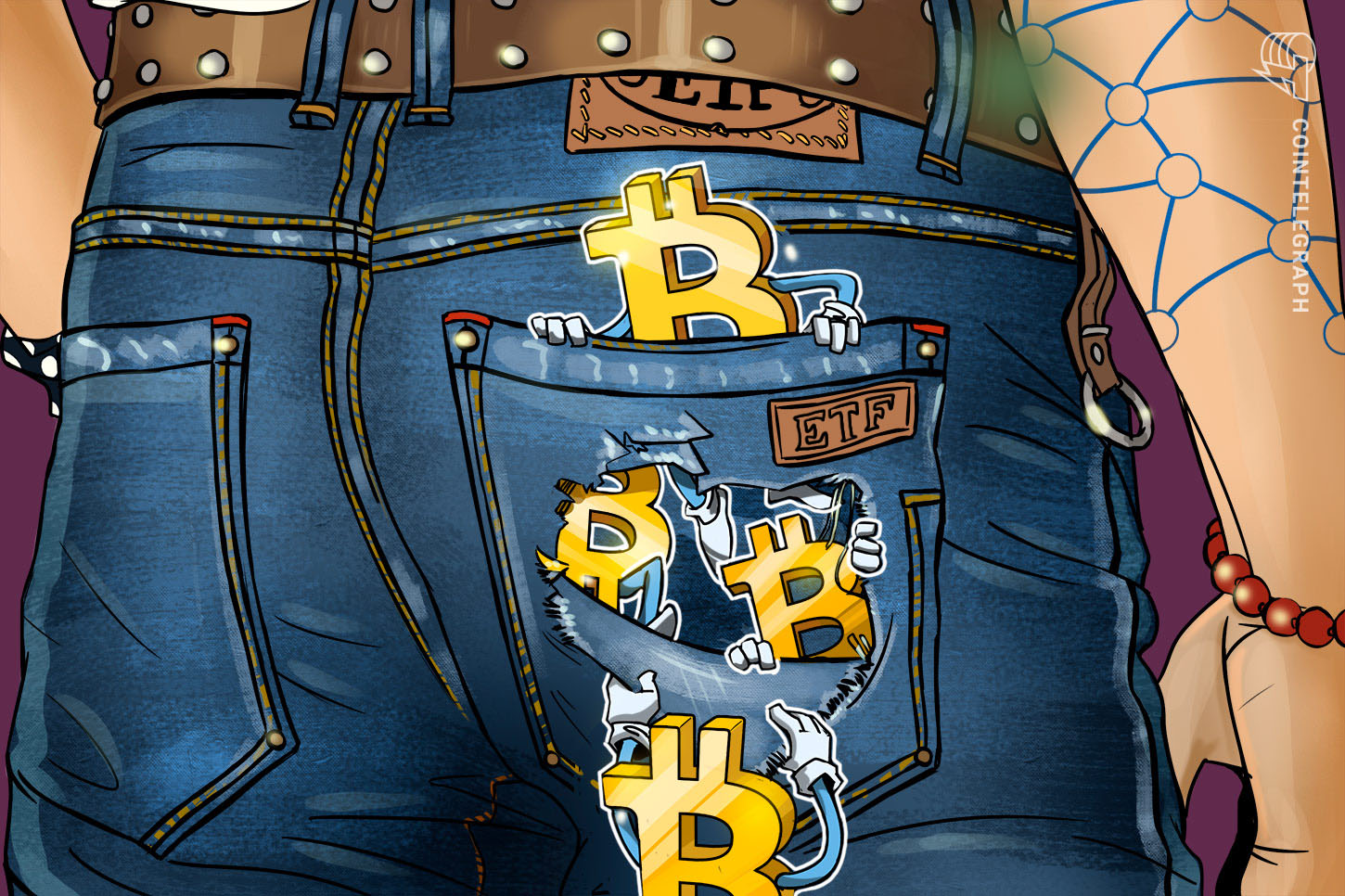 A week-long streak of inflows into US spot Bitcoin ETFs has coincided with the Coldcard wallet exploit, fueling debate over whether some investors are shifting away from self-custody. Demand for US spot Bitcoin exchange-traded funds (ETFs) has accelerated over the past week, with a string of daily inflows coinciding with the Coldcard wallet hack — timing that has prompted speculation about whether some investors are reconsidering self-custody. According to Bloomberg senior ETF analyst Eric Balchunas, BlackRock’s iShares Bitcoin Trust (IBIT), Fidelity Wise Origin Bitcoin Fund (FBTC), Bitwise Bitcoin ETF (BITB), ARK 21Shares Bitcoin ETF (ARKB) as well as Defiance Daily Target 2X Long MSTR ETF (MSBT) have recorded inflows every trading day since the weekend exploit, totaling roughly $620 million. The cumulative figure is consistent with Cointelegraph’s recent reporting on the ETF inflow streak. The Coldcard exploit drained more than $116 million worth of Bitcoin from over 5,200 wallet addresses, according to blo...
 -
Cointelegraph.com - 17:17 Aug 06, 2026
 Three circuit judges disputed the former FTX CEO’s claims that the defunct crypto exchange’s investors could have been made whole and wouldn’t have experienced any losses. The US Court of Appeals for the Second Circuit issued a formal mandate upholding the conviction and sentence of former FTX CEO Sam “SBF” Bankman-Fried, reducing the number of potential opportunities for being released from prison early. On Tuesday, the Second Circuit filed a mandate following its June 12 ruling affirming a lower court decision convicting the former CEO on seven felony counts and sentencing him to 25 years in federal prison. Three circuit judges disputed Bankman-Fried’s claims in appeals that FTX had “sufficient liquidity to ensure that investors were made whole and would not experience any losses” and also upheld a New York court’s $11 billion forfeiture order as part of the criminal case. “As the district court recognized, any contention that Bankman-Fried lacked an intent to defraud because he intended to eventually repay...
 -
Cointelegraph.com - 16:53 Aug 06, 2026
 The South Carolina lawmaker who heads the Senate Banking Committee said that the majority leader still had time to put the crypto bill on the agenda despite the narrow voting window. Senator Tim Scott, who chairs the Senate Banking Committee, said that the chamber would vote on the Digital Asset Market Clarity (CLARITY) Act before it broke for an August recess, giving lawmakers just a few days to take action on the crypto bill. In a Thursday Fox Business interview, Scott said that the Senate “should have the first vote” on the CLARITY Act before lawmakers leave for state work periods this week. He added that Senate Majority Leader John Thune, who has the authority to set the agenda and schedule floor votes, still had time to announce a cloture vote on the crypto bill in the next few days. “The good news is we have the time to get it done,” said Scott. Read more
 -
Cointelegraph.com - 16:42 Aug 06, 2026
 New analysis finds AI infrastructure contracts are becoming larger and more profitable, but investors now demand stronger execution before rewarding bitcoin mining stocks. Bitcoin miners’ pivot into artificial intelligence and high-performance computing (HPC) is reshaping their business models, but investors are no longer rewarding new infrastructure deals with the same enthusiasm they once did, suggesting the market has become more discerning as AI hosting strategies move into the mainstream. According to new analysis by Blocksbridge Consulting published in TheEnergyMag’s Miner Weekly, the market reaction to AI infrastructure announcements has weakened significantly over the past two years. Reviewing 25 AI and HPC infrastructure deals announced between June 2024 and August 2026, the report found that the average announcement-day stock move fell from roughly 24% for the earliest deals to about 10% for the most recent ones. Median gains also dropped by roughly half over the same period, even as the size and va...
 -
Cointelegraph.com - 16:24 Aug 06, 2026
 Bitcoin price action stayed compressed in an ongoing divergence from stocks and gold while US PMI data sparked fresh talk of “stagflation.” Bitcoin (BTC) stayed motionless at Thursday’s Wall Street open as analysis saw signs of reemergent US “stagflation.” Key points: Data from TradingView showed BTC/USD hovering above $64,000, down around 0.5% on the day, while US stocks opened flat. Read more
 -
Cointelegraph.com - 13:52 Aug 06, 2026
 Move-to-earn project Step App will wind down services by Aug. 21 after four years, while its FITFI token trades 99.9% below its all-time high. Step App, a move-to-earn platform, is shutting down after four years of operation, joining a growing number of crypto companies winding down amid an ongoing market slump. The company announced Wednesday on X that it will wind down all services by Aug. 21, asking users to unstake locked tokens and manage their exchange positions before the date. “We are incredibly proud of what Step App achieved — not just as a product, but as a movement,” Step App said. Read more
 -
Cointelegraph.com - 13:30 Aug 06, 2026
 Tokenized cows may have gone viral, but they’re just the latest in a long line of strange things to find a home onchain, from farts, to human skin and destroyed artworks Brazil’s B3 stock exchange made headlines last month when its tokenized cows went viral. A farmer in southern Brazil was able to use 10 cows as collateral for a 100,000 Brazilian real ($19,600) loan by virtually herding them into a blockchain based holding pen, demonstrating how farmers can literally milk their assets to access credit. And it raises an obvious question: if cows can be tokenized, what can’t be? Read more
 -
Cointelegraph.com - 13:00 Aug 06, 2026
 Blockchain.com secured a VASP custody license from the Cayman Islands Monetary Authority, expanding its regulated crypto services in the region. Blockchain.com has secured a virtual asset service provider (VASP) license from the Cayman Islands Monetary Authority to offer custody services. Granted on July 22, 2026, the license allows the cryptocurrency services company to provide regulated crypto custody services in the Cayman Islands, according to a Thursday announcement reviewed by Cointelegraph. The license followed a conditional approval issued by CIMA in December 2025. The license also allows Blockchain.com to provide crypto-to-fiat and crypto-to-crypto exchange services. The company has held a VASP registration in the Cayman Islands since May 2022. Read more
 -
Cointelegraph.com - 12:55 Aug 06, 2026
Tokenized real-world assets accounted for more than a third of Hyperliquid’s quarterly trading volume, generating 6.6% of the protocol’s $169 million quarterly revenue. Tokenized real-world asset (RWA) trading now accounts for more than 33% of the trading activity on decentralized exchange Hyperliquid. HIP-3 RWA perpetual contracts saw their share of trading volume increase to 32.2% during the second quarter of 2026, up from 20.7% in Q1 and 1.8% in Q4 of 2025. RWA trading volume reached $213 billion during Q2 on Hyperliquid, according to its quarterly report published on Wednesday. Hyperliquid said that RWA trading generated 6.6% of the protocol’s quarterly revenue of $169 million. Of that $169 million, the platform said it returned $141 million to token holders through Hyperliquid (HYPE) token buybacks. Hyperliquid reported over $1 billion in cumulative protocol revenue. Read more -
Cointelegraph.com - 12:11 Aug 06, 2026
 The self-custodial Bitcoin Lightning Network wallet disabled infrastructure after an incident and founder Evan Kaloudis said no customer funds were lost and no Lightning vulnerability was found. Zeus Wallet, a self-custodial Bitcoin Lightning Network wallet, took its infrastructure offline after a cybersecurity incident on Wednesday, and is auditing its systems before restoring services. In an X post announcing the incident, Zeus said the attack did not put customer funds at risk and that it had no evidence the incident affected Lightning node software. “Based on our investigation so far, we believe this incident was limited to Zeus infrastructure,” Zeus founder Evan Kaloudis said in a company blog post. According to Kaloudis, Zeus mitigated the attack within hours. He said that customers whose Lightning Service Provider (LSP) channels closed during the incident will receive replacement channels once services resume. Read more
 -
Cointelegraph.com - 12:00 Aug 06, 2026
 While only 12 of 46 documented attempts resulted in payment, data leaks and attacks on relatives are widening the physical risks facing crypto holders. Criminals stole more than $30 million through physical attacks on crypto holders in the first half of this year, putting the year on pace to surpass the record $58 million stolen in 2025. In a Chainalysis report released Thursday, the blockchain analytics firm said that 46 violent crypto-related incidents had been documented globally through late June, up from 40 during the same period in 2025. The incidents include kidnappings, home invasions and hostage situations, collectively known as “wrench attacks.” The findings suggest wrench attacks are increasing, expanding the risks facing crypto holders beyond custody and asset management to their physical safety, homes and families. Read more
 -
Cointelegraph.com - 11:48 Aug 06, 2026
 Doubts emerge over the Bitcoin corporate treasury model as institutional BTC investment vehicles cut holdings. Bitcoin (BTC) institutional investment vehicles have shed 10% of their BTC holdings since May as analysis warns of a “breaking” sector. Key points: Read more
 -
Cointelegraph.com - 11:26 Aug 06, 2026
 Hackers behind the Coldcard exploit transferred millions in digital assets to cryptocurrency mixers, while most stolen funds remained traceable in attacker-controlled wallets. About 64 Bitcoin, worth $4.17 million, and 200 Ether, worth $380,000, linked to the recent Coldcard exploit were sent to cryptocurrency mixing protocols, according to blockchain security platform CertiK. The Bitcoin transfer was from address bc1q0 to crypto mixing protocol Wasabi on Tuesday, according to blockchain data shared by CertiK. “We think it might be a smaller exploiter. There’s likely a few copycats after the initial exploit,” a CertiK spokesperson told Cointelegraph. The 200 Ether (ETH) was transferred to Tornado Cash on Wednesday, according to CertiK’s X post. Read more
 -
Cointelegraph.com - 10:41 Aug 06, 2026
 Situational Awareness reportedly made a $400 million investment in an undisclosed company, days after the hedge fund nearly collapsed following July’s AI stock crash. Situational Awareness, the hedge fund founded by former OpenAI researcher Leopold Aschenbrenner, reportedly invested $400 million in a privately held company days after it nearly collapsed under margin calls. The fund invested $100 million in the same unnamed company in July, Bloomberg reported Thursday, citing people familiar with the matter. The latest investment was completed on Tuesday. Cointelegraph has approached Situational Awareness for comment. Read more
 -
Cointelegraph.com - 09:38 Aug 06, 2026
 Russian President Vladimir Putin signed a crypto law establishing market rules for exchanges, custodians and investors, with core provisions taking effect in September 2026. Russian President Vladimir Putin has signed a law creating a regulated framework for cryptocurrency markets in Russia. Putin signed bill No. 1194918-8, titled “On Digital Currencies and Digital Rights,” into law on Tuesday, according to official records from the State Duma, Russia’s lower house of parliament. The legislation establishes rules for crypto market participants, including exchanges, brokers, custodians and other crypto service providers. The law requires crypto exchange operators to meet regulatory requirements and join a financial market self-regulatory organization. It limits retail investors to buying approved crypto assets through intermediaries, with an annual cap of 300,000 rubles ($3,700) per intermediary. Qualified investors will be allowed to purchase any cryptocurrency without such restrictions. Read more
 -
Cointelegraph.com - 09:28 Aug 06, 2026
 Tokenized real-world assets moved beyond issuance as RWA deposits more than tripled to $7.4 billion, while lending and trading activity expanded despite a broader industry slowdown. Real-world assets (RWAs) are gaining momentum as tokenized versions of traditional investments move beyond issuance and become active parts of onchain financial markets. RWA deposits across decentralized finance platforms more than tripled year over year to $7.4 billion in the second quarter of 2026, while total DeFi deposits fell about 15%, according to a joint report by CoinShares and Token Terminal published Thursday. CoinShares CEO Jean-Marie Mognetti said the divergence shows that RWA demand is being driven by practical use cases rather than broader market conditions. Read more
 -
Cointelegraph.com - 08:44 Aug 06, 2026
 JPYC said it plans to use the new capital to expand its financial and Web3 ecosystem and accelerate adoption of its yen-pegged token. Japanese yen stablecoin issuer JPYC has completed an extension of its Series B funding round, bringing the round’s cumulative total to about 6 billion yen ($38 million). On Wednesday, the company said Japanese logistics group AZ-COM Maruwa Holdings joined the round as a new investor. JPYC said it plans to use the proceeds to expand its financial and Web3 ecosystem and accelerate the adoption of its yen-pegged stablecoin. JPYC did not disclose the exact amount raised through the extension or the size of AZ-COM’s investment. However, the round’s cumulative total increased by about 1 billion yen from about 5 billion yen announced in May. It also did not provide financial terms for the companies’ capital and business alliance. Read more
 -
Cointelegraph.com - 07:56 Aug 06, 2026
 Nasdaq-listed PowerCompute refinanced $18 million of debt through a Bitcoin-backed facility carrying an initial interest rate of about 2%. Nasdaq-listed Bitcoin mining company PowerCompute has consolidated its three existing debt facilities totaling $18 million under a new Bitcoin-backed credit facility with Arch Lending. PowerCompute pledged 307 Bitcoin (BTC) from its treasury as collateral. The company entered an initial bridge loan with Arch on July 27 before entering into the new facility on Monday, according to a Wednesday press release shared with Cointelegraph. The new facility replaced PowerCompute’s previous $11 million loan from Galaxy Digital, a $5 million loan from SE and AJ Liebel used to purchase a 15-megawatt Oklahoma facility and another $2 million loan from Liebel used to purchase an 11-megawatt Mississippi facility. Read more
 -
Cointelegraph.com - 06:57 Aug 06, 2026
 US-listed Bitcoin ETFs attracted $244.4 million on Wednesday, marking three consecutive inflow days for a combined $626 million. US-listed spot Bitcoin exchange-traded funds (ETFs) attracted $244.4 million in net inflows on Wednesday. Spot Bitcoin ETFs have kicked off August by fetching $626 million in net inflows over three consecutive days, according to SoSoValue data. BlackRock’s iShares Bitcoin Trust ETF (IBIT) led the gains, attracting $479 million over the three-session period and lifting its cumulative net inflows to nearly $61 billion, according to Farside Investors data. Read more
 -
Cointelegraph.com - 06:07 Aug 06, 2026
 Criminals are reportedly using fake websites and falsified documents to target customers searching for licensed crypto providers. Fraudsters are impersonating financial regulators and crypto businesses to target customers of crypto service providers that have failed to secure European Union licenses, according to officials cited by the Financial Times. Several of the bloc’s watchdogs have reportedly seen an increase in scams since the July 1 deadline that required firms to obtain authorization under the Markets in Crypto-Assets (MiCA) Regulation. Companies that failed to secure approval must wind down or transfer their EU operations, forcing customers to move their assets. Stéphane Pontoizeau, an official at France’s Autorité des Marchés Financiers (AMF), said the regulator encountered cases in which fraudsters impersonated AMF representatives, directing users to transfer assets to them through fake websites. Read more
11869 items