Cointelegraph.com
Source:
https://cointelegraph.com
Found 11869 news
-
Cointelegraph.com - 23:27 Jul 28, 2026
 Myanmar lawmakers approved an anti-online scam bill whose draft proposed prison terms of 10 years to life for crypto scams and operating scam centers. Myanmar’s Parliament passed an anti-online scam bill that would impose prison terms of 10 years to life for crypto scams and operating online scam centers. The Pyidaungsu Hluttaw, Myanmar’s combined Parliament, approved the bill in its entirety on Tuesday after resolving differences between versions previously passed by its two chambers, according to the state-run Global New Light of Myanmar (GNLM). The report did not say whether the bill had received presidential assent or when it would take effect. The legislation is Myanmar’s latest attempt to curb a growing cyberscam industry that has turned parts of the country into hubs for online fraud. Read more
 -
Cointelegraph.com - 21:57 Jul 28, 2026
 Visa said it is investing across the stablecoin stack, highlighting OpenUSD, tokenized deposits and AI-powered commerce during the company’s third-quarter earnings call. Visa reported fiscal third-quarter revenue of $11.6 billion, up 14% from a year earlier, driven by double-digit growth in payments volume, cross-border volume and processed transactions. During the company’s earnings call, Visa outlined its broader stablecoin strategy, saying it has been investing across multiple layers of the stablecoin ecosystem. The company said: Visa added that it had joined the OpenStandard consortium, which plans to issue the OpenUSD stablecoin for global money movement. The company said the Visa stablecoin platform is designed to enable partners to settle with Visa in stablecoins, provide onchain wallet-as-a-service infrastructure and move money between fiat currencies and stablecoins, beginning with OpenUSD. Read more
 -
Cointelegraph.com - 21:57 Jul 28, 2026
Visa said it is investing across the stablecoin stack, highlighting OpenUSD, tokenized deposits and AI-powered commerce during the company’s third-quarter earnings call. Visa reported fiscal third-quarter revenue of $11.6 billion, up 14% from a year earlier, driven by double-digit growth in payments volume, cross-border volume and processed transactions. During the company’s earnings call, Visa outlined its broader stablecoin strategy, saying it has been investing across multiple layers of the stablecoin ecosystem. The company said: Visa added that it had joined the OpenStandard consortium, which plans to issue the OpenUSD stablecoin for global money movement. The company said the Visa stablecoin platform is designed to enable partners to settle with Visa in stablecoins, provide onchain wallet-as-a-service infrastructure and move money between fiat currencies and stablecoins, beginning with OpenUSD. Read more -
Cointelegraph.com - 20:10 Jul 28, 2026
 The new exchange-traded products track Ether and Solana, offer staking rewards and follow the firm’s Bitcoin fund launched earlier this year. Morgan Stanley Investment Management has launched Ether and Solana exchange-traded products, expanding its fund lineup beyond Bitcoin. The Morgan Stanley Ethereum Trust (NYSE Arca: MSSE) and Morgan Stanley Solana Trust (NYSE Arca: MSOL) seek to track the performance of Ether (ETH) and Solana (SOL), respectively, using the CoinDesk Ether Benchmark 4PM NY Settlement Rate and CoinDesk Solana Benchmark 4PM NY Settlement Rate. Both funds carry a 0.14% expense ratio and intend to stake a portion of their holdings, with staking rewards passed through to investors. Morgan Stanley said it will not retain any portion of the staking rewards earned by either fund. Read more
 -
Cointelegraph.com - 20:10 Jul 28, 2026
The new exchange-traded products track Ether and Solana, offer staking rewards and follow the firm’s Bitcoin fund launched earlier this year. Morgan Stanley Investment Management has launched Ether and Solana exchange-traded products, expanding its fund lineup beyond Bitcoin. The Morgan Stanley Ethereum Trust (NYSE Arca: MSSE) and Morgan Stanley Solana Trust (NYSE Arca: MSOL) seek to track the performance of Ether (ETH) and Solana (SOL), respectively, using the CoinDesk Ether Benchmark 4PM NY Settlement Rate and CoinDesk Solana Benchmark 4PM NY Settlement Rate. Both funds carry a 0.14% expense ratio and intend to stake a portion of their holdings, with staking rewards passed through to investors. Morgan Stanley said it will not retain any portion of the staking rewards earned by either fund. Read more -
Cointelegraph.com - 18:47 Jul 28, 2026
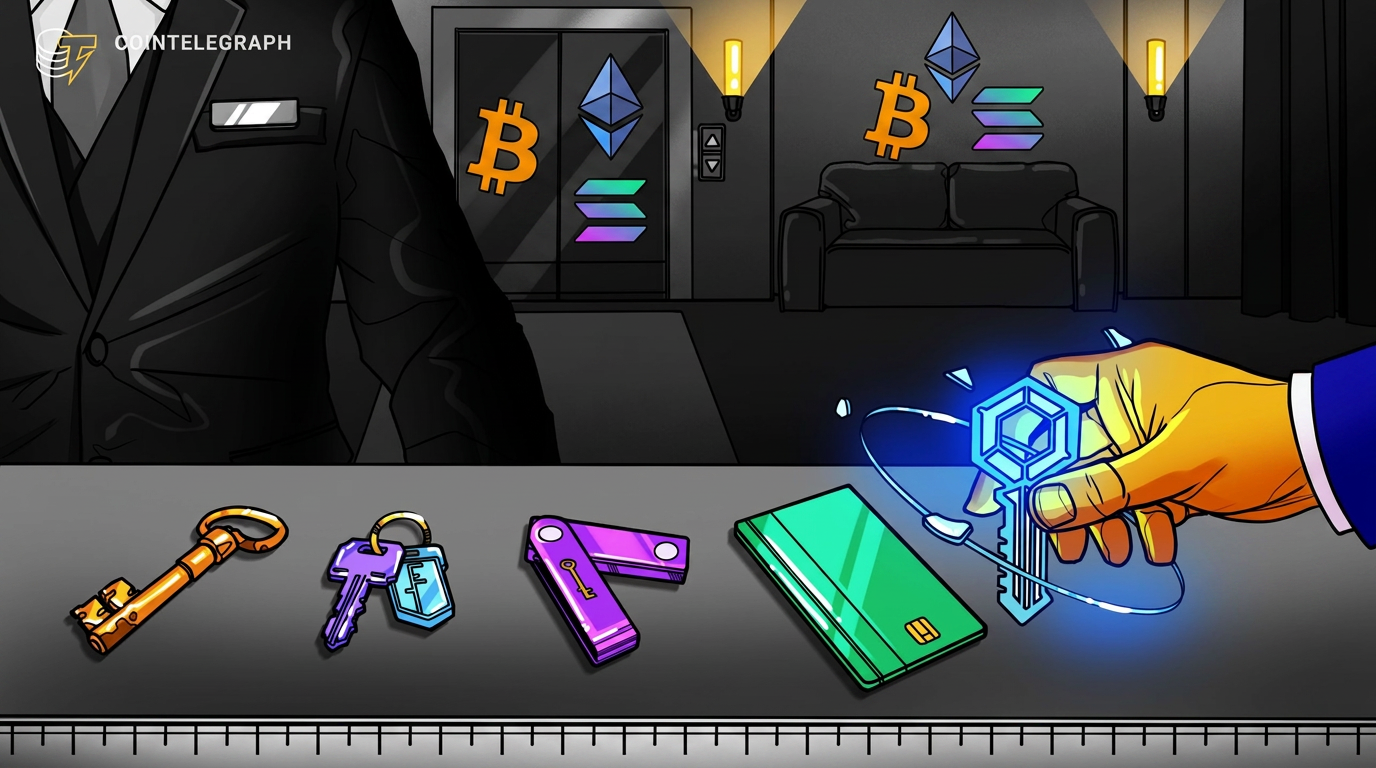 The proposed cryptographic scheme aims to protect existing Bitcoin, Ethereum and Solana wallets from future quantum attacks without requiring users to move funds or change wallet addresses. Blockchain security company AmericanFortress has unveiled a cryptographic scheme that it says could protect existing cryptocurrency wallets from future quantum attacks without requiring users to move funds, rotate keys or change wallet addresses. Unlike most proposed post-quantum approaches, AmericanFortress said its scheme allows existing wallet addresses to remain unchanged while adding post-quantum protection. The company published the proposal in a technical paper on the Cryptography ePrint Archive, describing the scheme as compatible with seed-based hierarchical deterministic wallets used across Bitcoin (BTC), Ethereum (ETH), Solana (SOL) and other blockchain networks that rely on elliptic curve cryptography. The paper has not yet been peer-reviewed. Read more
 -
Cointelegraph.com - 18:08 Jul 28, 2026
 The crypto-focused companies announced separate acquisitions as demand for power-intensive AI and digital infrastructure continues to grow. Crypto companies continued to expand their physical footprint in Texas, with Galaxy Digital and MARA Holdings announcing separate land acquisitions tied to AI, high-performance computing (HPC) and Bitcoin mining infrastructure. On Tuesday, Galaxy Digital, a crypto financial services and infrastructure company, said it acquired a 500-acre site in McGregor, Texas, where it plans to build its second AI and high-performance computing (HPC) data center campus in the state. The project is expected to launch with 74 megawatts of power capacity before expanding in later phases. MARA Holdings, a Bitcoin miner and digital infrastructure company, separately announced an agreement to acquire a 1,200-acre powered site in Matagorda County with access to up to 2 gigawatts of power capacity. The company said it intends to develop the site for AI and HPC workloads as well as bitcoin minin...
 -
Cointelegraph.com - 16:27 Jul 28, 2026
 Bitcoin and crypto dropped as contagion from a major Asia stock-market correction spreads to the US at the Wall Street open. Bitcoin (BTC) hit ten-day lows at Tuesday’s Wall Street open as BTC price action followed a US stocks sell-off. Key points: Semiconductor-led losses from Asia spilled over into US trading. South Korea’s KOSPI Index finished the day down 10.8% in a single session, fueled by 14.8% losses for chip-maker SK Hynix, while Japan’s memory manufacturer Kioxia Holdings fell 18.3% on the day. Read more
 -
Cointelegraph.com - 16:20 Jul 28, 2026
 Eligible US users can request IPO allocations, while customers in more than 110 countries gain access to tokenized Jersey Mike’s shares backed 1:1 by the underlying stock. Crypto exchange Kraken is offering retail investors access to the planned Jersey Mike’s initial public offering, allowing eligible US customers to request allocations of the sandwich chain’s shares and users in more than 110 countries to request tokenized shares backed 1:1 by the underlying stock. Eligible US customers can submit interest in book-entry Jersey Mike’s shares at the IPO price, while global customers can request JMKEx, a tokenized version of the stock with the backing shares held in regulated custody. Allocations are determined by the IPO underwriter and are not guaranteed. JMKEx will begin trading 24 hours a day, five days a week on Kraken and participating xStocks Alliance platforms once the IPO closes, while the underlying Jersey Mike’s shares will trade during regular US market hours. Read more
 -
Cointelegraph.com - 16:20 Jul 28, 2026
Eligible US users can request IPO allocations, while customers in more than 110 countries gain access to tokenized Jersey Mike’s shares backed 1:1 by the underlying stock. Crypto exchange Kraken is offering retail investors access to the planned Jersey Mike’s initial public offering, allowing eligible US customers to request allocations of the sandwich chain’s shares and users in more than 110 countries to request tokenized shares backed 1:1 by the underlying stock. Eligible US customers can submit interest in book-entry Jersey Mike’s shares at the IPO price, while global customers can request JMKEx, a tokenized version of the stock with the backing shares held in regulated custody. Allocations are determined by the IPO underwriter and are not guaranteed. JMKEx will begin trading 24 hours a day, five days a week on Kraken and participating xStocks Alliance platforms once the IPO closes, while the underlying Jersey Mike’s shares will trade during regular US market hours. Read more -
Cointelegraph.com - 15:47 Jul 28, 2026
 Core Scientific reported strong second-quarter revenue growth as AI colocation became its largest business, though a non-cash accounting charge resulted in a $1.15 billion net loss. Digital infrastructure company Core Scientific more than doubled its second-quarter revenue as rapid growth in its artificial intelligence and high-performance computing (HPC) colocation business continued to reshape its earnings profile following its pivot beyond Bitcoin mining. The company reported Tuesday that Q2 revenue increased to $164.2 million, up from $78.6 million a year earlier. Colocation revenue accounted for $136.7 million of the total, compared with just $10.6 million in the same period last year, while gross profit increased to $70 million from $5 million. Despite the revenue surge, Core Scientific reported a net loss of $1.15 billion, driven primarily by a non-cash accounting charge related to the rising value of outstanding warrants as its share price increased. Read more
 -
Cointelegraph.com - 13:30 Jul 28, 2026
 DeFi projects that survived the fallout from the Terra and FTX collapses in 2022 are dying out in 2026. But analysts say it’s not a case of industry consolidation — but the opposite. When DeFi dashboard Zapper announced this month that it would shut down after nearly seven years, it joined a growing list of decentralized finance projects that have folded in 2026. Bitcoin DeFi platform Botanix, Solana portfolio tracker Step Finance, DeFi analytics platform Parsec and DEX aggregator Odos Protocol also wound down or are winding down this year after multiple market cycles. The carnage isn’t limited to DeFi — RootData has tracked 101 “dead” crypto projects in total this year as of July 26 — but it accounts for more than half the cadavers. Read more
 -
Cointelegraph.com - 13:11 Jul 28, 2026
 Analysis warned of a repeat of the 2024 yen carry-trade unwind that pressured crypto markets ahead of the next Bank of Japan interest-rate meeting. Japan’s central bank is in focus this week as its next interest-rate meeting comes amid new 40-year yen lows against the US dollar. Key points: Data from TradingView showed USD/JPY approaching 164 on Tuesday, just a fraction below new 40-year highs seen last week. Read more
 -
Cointelegraph.com - 13:00 Jul 28, 2026
 Blockaid found Ethereum remained the hardest-hit blockchain in H1 2026, while Solana replaced Arbitrum as the network with the second-highest losses, driven largely by key compromises. Crypto losses topped $1 billion in the first half of 2026 as the industry recorded its highest number of hacks in a six-month period, according to onchain security platform Blockaid. Ethereum and Solana recorded the largest losses from incidents affecting their networks, with roughly $332 million and $326 million in stolen funds, respectively, Blockaid said in its H1 2026 security report published Tuesday. Blockaid tracked 212 security incidents during the period, with the largest single exploit coming from KelpDAO at $292 million, while the platform verified 3.4 times as many high-threshold exploits in H1 2026 as across all of 2025. Read more
 -
Cointelegraph.com - 12:07 Jul 28, 2026
 PayPal highlighted growth of stablecoins and AI-driven payment tools in Q2 while reporting $8.68 billion in revenue and an $81 million crypto-related earnings adjustment. Global payments giant PayPal highlighted stablecoins and artificial intelligence-driven payment tools as part of its second-quarter strategy while crypto assets remained part of its earnings reconciliation. PayPal reported Q2 earnings of $1.26 per share on Tuesday, compared with $1.30 per share in the same period last year and below analysts’ $1.28 estimate. Revenue reached $8.68 billion, up from $8.29 billion a year earlier and above the $8.47 billion analyst consensus. The company also recorded an $81 million non-GAAP adjustment related to gains and losses from strategic investments and crypto assets held for investment. PayPal said it excludes gains and losses from strategic investments and crypto assets held for investment from non-GAAP results because it does not actively trade those assets or rely on them to fund ongoing operations. Re...
 -
Cointelegraph.com - 11:00 Jul 28, 2026
 Decentralized exchange aggregator 1inch announced the launch of its Aqua protocol allowing users to provide liquidity to many protocols at once. Decentralized exchange aggregator 1inch announced Aqua, a protocol aimed at unifying the liquidity pools of numerous markets in the decentralized finance ecosystem. According to Tuesday’s announcement, Aqua allows liquidity providers to authorize several strategies against one wallet inventory, while the assets remain in the wallet until a trade settles, rather than depositing the funds to any particular liquidity pool. The protocol has been deployed on 13 blockchains including Ethereum, Arbitrum, Base, Robinhood Chain and BNB Chain. Source: 1inch Read more
 -
Cointelegraph.com - 10:09 Jul 28, 2026
 The IMF said Brazil’s stablecoin market has expanded rapidly since 2017, with cross-border crypto flows growing faster than traditional capital flows. The International Monetary Fund said Brazil’s crypto asset market, particularly US dollar-pegged stablecoins, has expanded rapidly since 2017 and requires closer oversight as cross-border crypto flows grow faster than traditional capital flows. In its Financial System Stability Assessment released Thursday, the IMF said stablecoins have played a key role in the significant growth of Brazil’s crypto asset market. The report said cross-border crypto flows have “been steadily increasing” and that stablecoin purchases are two to three times more sensitive to global shocks than traditional portfolio investment or foreign direct investment flows. The IMF said Banco Central do Brasil (BCB) has already taken steps to regulate crypto asset service providers, but gaps remain in areas such as customer asset protection, stablecoin issuance rules and anti-money laundering (...
 -
Cointelegraph.com - 09:14 Jul 28, 2026
 Lido launched Curated Module v2, an upgrade that could reduce Ethereum’s validator count by one-third by consolidating validators and introducing new operator rules. Lido, a liquid staking protocol that lets users earn Ethereum staking rewards through its stETH token, has launched an upgrade to its staking infrastructure that aims to improve validator efficiency and decentralization. The upgrade introduces Curated Module v2, which adds support for Ethereum’s 0x02 withdrawal credentials. The change allows validators to increase their effective balance from 32 ETH to as many as 2,048 ETH, according to a Lido update on Monday. Lido said the migration could reduce Ethereum’s validator count to about 628,000 from 880,000, a decrease of about one-third. The migration has not started yet, and the figures are based on Lido’s projections. Read more
 -
Cointelegraph.com - 09:12 Jul 28, 2026
 The new system marks an apparent departure from the institution-focused layer-1 blockchain Ondo announced in 2025. Real-world asset tokenization platform Ondo Finance has launched an offchain execution network in an apparent pivot away from the institution-focused layer-1 blockchain it introduced in 2025. The company said Monday that Ondo Network will handle trades away from public blockchains and is already being used by Ondo Perps, its perpetual futures platform. Traditional blockchains typically rely on distributed networks of computers to validate transactions and maintain shared state. Ondo Network instead runs its trading software inside one protected computing environment that the company calls “enclaves,” which are also known as Trusted Execution Environments in crypto parlance. A group of operators checks that the software has not been altered, and each holds part of the digital key needed to authorize transfers. Read more
 -
Cointelegraph.com - 07:40 Jul 28, 2026
 Three users allege a fake Sparrow Wallet app on Apple’s App Store drained their Bitcoin holdings, with losses totaling more than $1.8 million. Apple is facing a lawsuit from three customers who say they lost a combined $1.8 million after downloading a fake Bitcoin wallet app from the App Store. The complaint, filed Friday in the US District Court for the Northern District of California, alleges Apple failed to adequately review and monitor apps despite promoting the App Store as a trusted marketplace, according to a copy of the filing obtained by MacRumors. The plaintiffs, James Ramirez, Christopher Ellis and Jalen Delgado, said they entered their seed phrases into the fraudulent app, allowing scammers to transfer their Bitcoin. They reported losses of about $875,000, $840,000 and $120,000, respectively, during 2025, according to the complaint. Read more
11869 items